
How a Surrey author expressed her vulnerability through letters
One year after the release of The Silent Stoning, Jeeti Pooni is still trying to help others who have experienced abuse
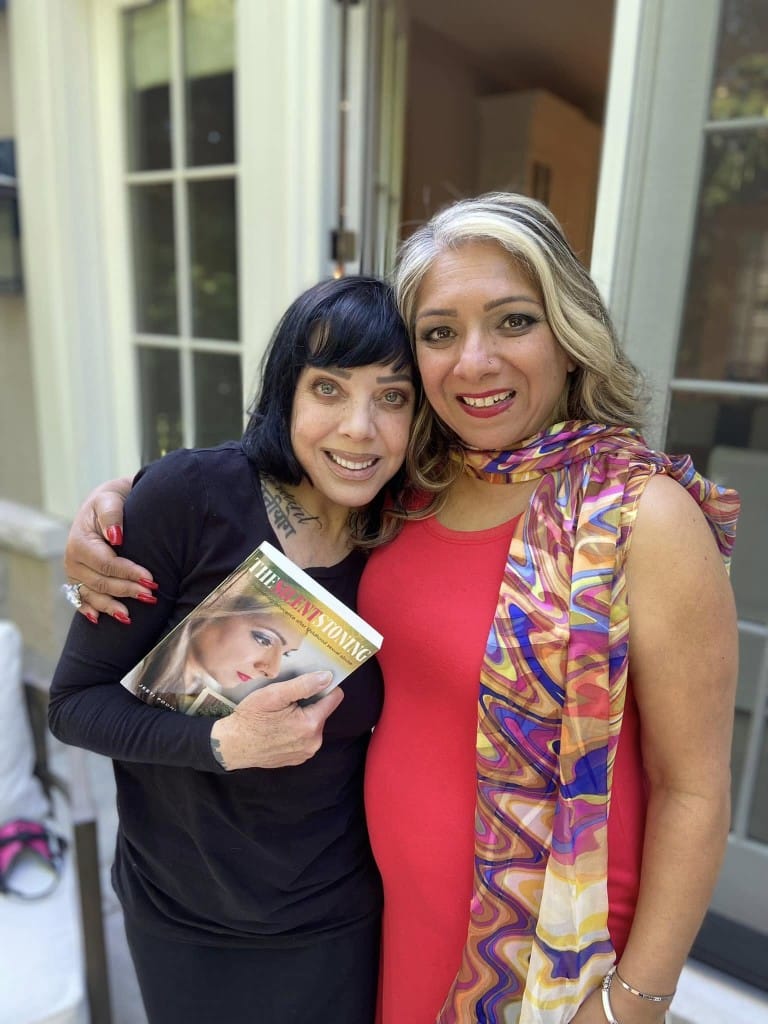
When Jeeti Pooni made up her mind, the words started oozing onto the page.
Eight years ago, Pooni decided to sit down and turn her life story into a book.
It came amid an ongoing court case against an older cousin, who started abusing Pooni when she was a child in the 1980s. The decision also came amid production on a documentary about her family’s story. (The documentary, Because We Are Girls, was released in 2019 to critical acclaim.)
But unlike many traditional memoirs, which may tell a story chronologically or in a first person point of view, Pooni decided to write as if she was talking to a younger version of herself, a decision that made the writing process a healing one too.
“Going back to those certain ages, I was able to be with that little Jeeti,” Pooni said. “I was able to hold the hand of that little girl, feel her tears, hold her and hug her.”
Her book, The Silent Stoning, was self-published and released in November 2023. It’s still available online and in multiple Surrey Public Libraries including the Newton, City Centre and Strawberry Hill branches.
The Silent Stoning is written in an epistolary format, a second-person, letter-like style that gives the reader a glimpse into the thoughts of a younger version of Pooni who struggled with the uncertainty of living with an abuser.
The format allowed Pooni to personify her younger self, explore the thoughts she had at the time and hand out advice that may be applicable to other survivors.
“I was able to witness, for once, exactly what she was feeling, what she wanted to say, what she wasn’t able to express. I allowed it to be expressed through this book,” said Pooni, who added that going to therapy helped her feel comfortable revisiting those memories on the page.
“It gave her a voice. And it’s not just giving her a voice. This is the voice of hundreds, thousands, millions of people that have been silenced.”
In 2006, Pooni first told her family about the assaults that were committed between 1980 and 1985 when she was living in Williams Lake.
Her sister, Salakshana and cousin, Rajinder Rana, also came out with similar stories of abuse from their cousin.
The cousin was eventually charged in 2011. He was found guilty of sexually assaulting the trio roughly seven years later. A 2021 B.C. Court of Appeal decision then reinforced the guilty verdict, however, it also found that the cousin would not be sentenced for his crimes — a verdict Pooni feared would dissuade women’s trust in the legal system.
“What message is the criminal justice system sending to other survivors? It’s telling them that you don’t matter,” she told News1130 in February 2021.
The 2021 verdict was yet another illustration of the ongoing stigma plaguing women — who are disproportionately impacted by sexual assaults and may fear reporting a sexual assault over the uncertainty that it will lead to a conviction.
In a recent report, Statistics Canada found six per cent of all sexual assault incidents were reported to police. That figure pales in comparison to the 36 per cent of physical assaults that were reported over the same time.
The report also found that one in three sexual assaults reported by police lead to charges.
The Silent Stoning, which was published nearly five years after the documentary, is an expansion of the issues discussed in the film. It’s also designed to help people heal from trauma, considering the high number of sexual assaults that go unreported.
Because We Are Girls introduced the subject of sexual abuse in the Indian community, a subject that isn’t often discussed in homes, Pooni said. The film gave permission for people to reflect, talk, or tell family members and friends about whether they had been impacted in a similar way.
“It was written for those that have been through stuff to know, ‘yes, these horrific stories happen, and yes, it’s very traumatic, and yes, you can come out the other side,’” Pooni said.
“It’s like I’m holding their hand through the book to lead them to the other side.”
That message has spread across the country.
Shortly after the book was released, Pooni held a book signing in Edmonton. One woman approached Pooni and explained how the book took her on an emotional journey that helped heal some trauma.
“She said, ‘This is helping her.’ She’s been to therapy before, but this is so different. That was her words,” Pooni said. “That’s what the book is written for.”
Now that Pooni has discussed her story in public, she’s hoping to help others in private. Down the road, she envisions leading groups of people on collaborative healing journeys in a safe, open space without fear or judgement. (Earlier this month, she announced that ‘sacred circles‘ — places where people can talk and heal in safe and supportive spaces — had launched.)
“That’s where I want to go — hold the safe space, be that listener and be that compassionate guide for others as they go through their healing journey,” Pooni said.
Author



Comments (0)
There are no comments on this article.