
45 Surrey school portables sitting empty due to high cost of moving them
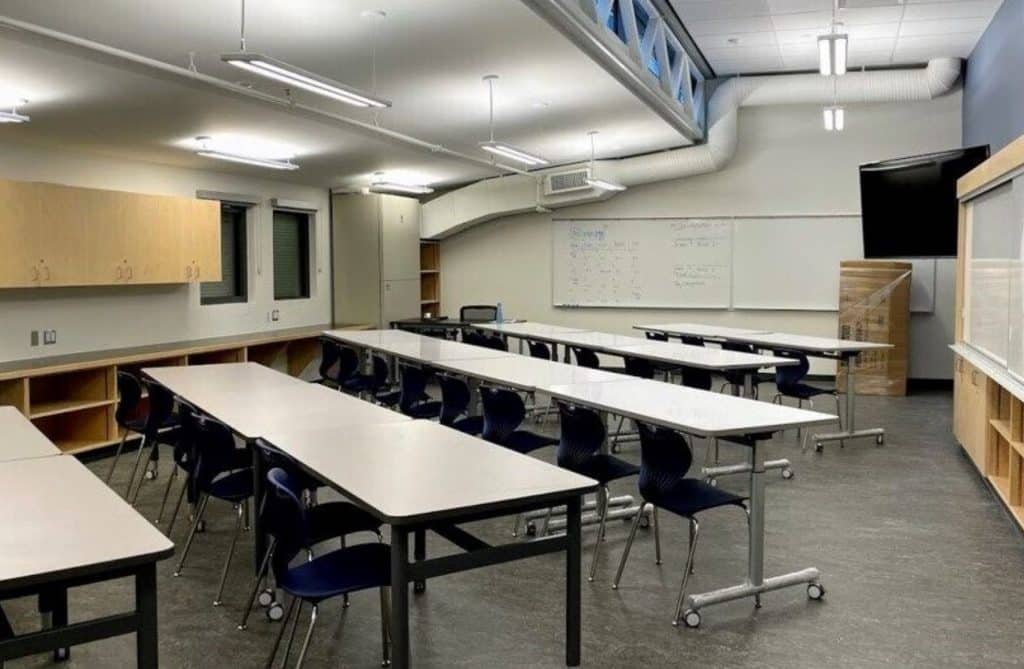
When you ask Surrey School Board chair Gary Tymoschuk about how many portable classrooms there are in the district, he says he hears the voice of former B.C. Premier John Horgan on the campaign trail vowing to get rid of them – all of them.
“That was like eight years ago,” Tymoschuk told the Surrey Citizen. “Now we have even more portables than we did then.”
That’s because the school district is growing faster than the provincial government can add new classroom spaces. More than 700 new classroom spaces were added this summer in Surrey, with 2,300 more starting construction.
But the school district still has 353 portables, Tymoschuk said, with 45 of them actually sitting empty because there are at schools that now don’t need them.
The problem is it costs more than $100,000 to move just one of the portables from one location to another, Tymoschuk said, and that cost has to be paid by the Surrey School District out of its operating budget.
Last school year, the Surrey School District had a budget shortfall of $16 million, which meant that cuts had to be made, Tymoschuk said, adding that trustees made a decision that they couldn’t sacrifice operations by spending money on moving portables.
“Two years ago, as a school board, we said ‘no more’,” Tymoschuk said. “We simply can’t afford to pay to move them. We said this absolutely makes no sense.”
The problem is the school district in Surrey just keeps on adding students as the city grows at an explosive pace that will only continue as the provincial government has set a five-year housing target for the city of more than 27,000 new net units.
Student enrollment is in the area of 83,000. A 2024 Surrey School District report detailed it had grown by an average of 2,598 students over the previous two years – triple the average over the previous decade.
Tymoschuk puts the blame on senior levels of government for not funding services to meet the demands of growth and immigration.
The provincial government says portable costs are the responsibility of an individual school district.
“As a trustee, I sometimes get asked why aren’t you building more schools and I respond that we’re simply not getting the funding for that,” Tymoschuk said.
For its part, the B.C. government says that since 2017, it’s spent $6 billion, including $1 billion in Surrey, to fund new schools and additions. For Surrey, that’s meant more than 16,000 new spaces.
B.C. Infrastructure Minister Bowinn Ma said that the previous BC Liberal government did not build a single school in the previous four years.
“Schools are critical to families with children in Surrey, and we’re committed to delivering modern, safe learning spaces for this fast-growing community,” said Ma. “As Surrey grapples with the challenges of extraordinarily rapid increases in student enrolment, we are doing our part with record investments into new and expanded facilities. With new classrooms opening this fall and even more starting construction, we’re making real progress to give students the spaces they deserve, and there’s more to do.”
In fall 2025, more than 700 new student seats are opening at new classrooms in Surrey:
- Woodland Park Elementary – 400 new seats
- Walnut Road Elementary – 100 new seats
- Theresa Clarke Elementary – 225 new seats
Over the summer, construction started on more than 2,300 new seats for the following school projects:
- Kwantlen Park Secondary – 500 new seats
- Martha Currie Elementary – 150 new seats
- Old Yale Road Elementary – 425 new seats
- Latimer Road Elementary – 150 new seats
- William Watson Elementary – 300 new seats
- George Greenaway Elementary – 350 new seats
- Guildford Park Secondary – 450 seats
Since 2024, the B.C. government has announced additions at Fleetwood Park, Kwantlen Park and Tamanawis Secondary schools, the opening of Ta’talu Elementary and new permanent spaces at Walnut Road, South Meridian and Semiahmoo Trail Elementary schools.
BC Conservative and Surrey North MLA Mandeep Dhaliwal blames “chronic underfunding” by the province for problems in local schools.
“Parents are right to be concerned: When learning centres, band programs, and classroom supports disappear, it’s out kids’ future that suffer,” Dhaliwal said. “Students’ health and well-being are at stake, and this government must finally put education first.”
Andy Yan is the director of the City Program at Simon Fraser University. He studies growth and its impact on communities, such as the pressure on the public education system. A major issue is how the B.C. Ministry of Education calculates its formula for approving new school construction or the expansion of an existing school.
“You have to show up with the kids first before building a school occurs,” Yan said. “I think that’s been a big challenge for how a place like Surrey is growing. It’s also the type of housing being built south of the Fraser where they’ of the size where they have lots of children. … You need the support of higher levels of government.”
Author



Comments (0)
There are no comments on this article.