
A quarter century later, this local Pride group is still going strong
How Surrey Pride celebrated its 25th anniversary last year. And is looking to play an even bigger part of the growing city’s future
The dance began how many late night ideas start: with a dare.
In the late 1990s, Martin Rooney was bowling with his partner and two friends, when one of them challenged him to accomplish something that had never been done in Surrey before.
Rooney, now 63, grew up in Ireland in the 1960s and 70s as the eldest of five children in his family. Like his siblings, Rooney was raised catholic. But as he got older, he started to gravitate away from the traditional catholic beliefs that were instilled in his mind as a child.
“I struggled when I realized that I was not into girls,” he said. “My lifestone was not kosher, let’s put it that way.”
He eventually moved to Vancouver in 1986 and ingrained himself in the LGBTQ2+ community — joining a gay bowling league in New Westminster, connecting with allies and fundraising for HIV/AIDS in the late-1980s.
“I left my home country to come here so I could be free, be Canadian, be gay and live my life,” Rooney said.
Rooney and his partner eventually moved to Surrey in 1996.
They didn’t know it at the time, but nearly three decades later, the two of them would play major roles in bringing more diversity to town.
Although the couple had a supportive group of LGBTQ2+ folks in Vancouver and suburbs like New Westminster, by the time they moved to Surrey, the city’s school district was in the midst of banning some LGBTQ2+ material.
At the time, an elementary school teacher, James Chamberlain, planned to use three children’s books that focused on diversity and same-sex relationships and parents in his curriculum. The school district, however, rejected his proposal. (The case was ultimately overturned by the Supreme Court of Canada in 2002).
So, as Rooney was awaiting his turn to bowl, on a summer evening roughly 26 years ago, one of his friends had an idea.
“We should have a dance,” they said.
“Why not have a gay dance in Surrey?” Rooney replied.
“Well, you’re never gonna be able to do that.”
“Watch me,” Rooney said.
The four of them, who initially called themselves Out in Surrey, a dual meaning referring to the act of coming out and moving to the suburbs, started spreading the word about a gay dance that was coming to the city.
All proceeds from the dance would also go towards fighting the school district’s book ban.
The promotion of LGBTQ2+ events was still uncommon in Surrey.
When someone moved to Surrey in the 1990s, it was assumed that you were aging, looking to settle down and move on from the clubs and nightlife in Vancouver. But even though there were few LGBTQ2+-specific events in Surrey at the time, there were pockets of people who were willing to support new Pride initiatives, Rooney said.
They just needed to tap into that network and bring a group of like-minded people together.
“There were no gay bars in town — we still don’t [have any] — but people wanted to connect,” Rooney said. “Out of those connections, mini groups formed, biking, walking, all of that stuff.”
The collective took out advertisements in the local newspaper, invited friends from their gay bowling league in New Westminster and asked all of the sub groups in the city to come together for the dance.
More than 200 people ended up attending the dance, raising $1,400 to the court case.
The dance also led to the formal creation of Surrey Pride, a registered non-profit society that held the first Pride Day in the city in 1999.
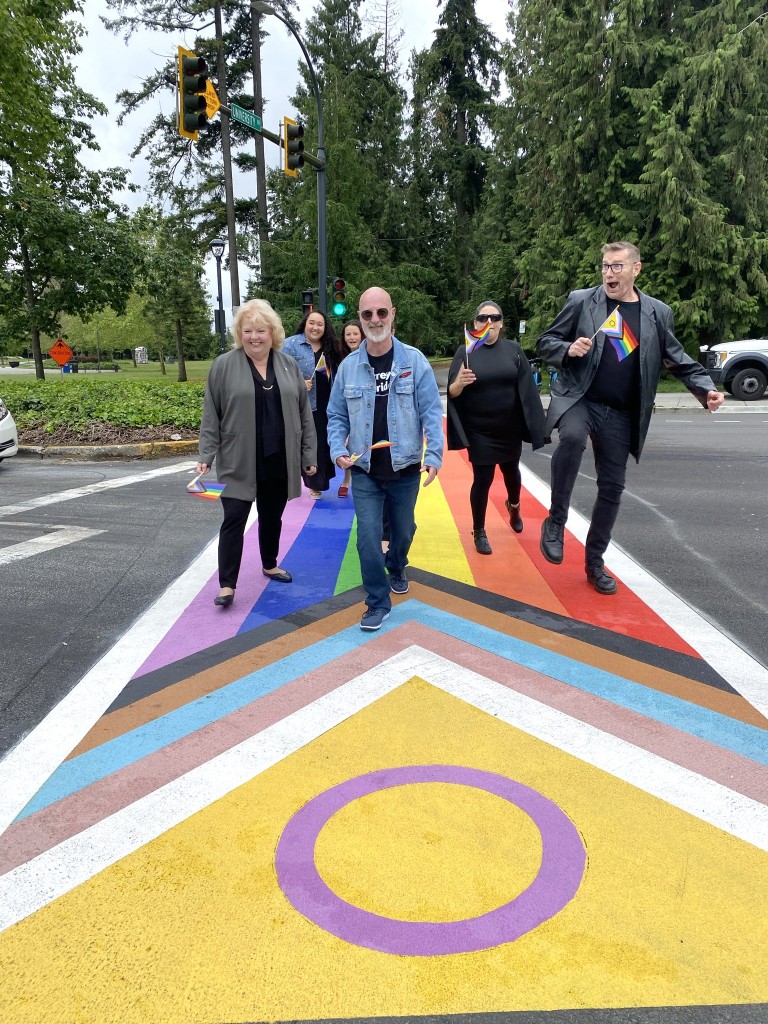
Since the non-profit was formed, awareness about LGBTQ2+ events and rights has increased for the better in Surrey. A Pride flag was raised for the first time at City Hall last year and the city has installed multiple rainbow crosswalks.
But there has also been a rise of protests against other LGBTQ2+ initiatives such as drag storytime performances and the introduction of Sexual Orientation and Gender Identity (SOGI) lessons in schools across the Lower Mainland.
Some critics say that the events encourage children to switch their gender, and that it goes against religious beliefs, according to a CBC article published last fall.
In 2023, specifically, protesters tried to disrupt a drag storytime event in Coquitlam. And earlier this month, a small group of protesters were rallying against SOGI, transgender children and the inclusion of Pride flags in schools at L.A. Matheson Secondary in Surrey.
As the group recently celebrated its 25th anniversary, Rooney says the organization is looking to honour its past while allowing the next generation of Pride advocates to take the organization — and the city — to new places.
“I turn 64 in a couple of months, I have no understanding of what it is to be in my teens, twenties or thirties living in this environment,” Rooney said.
The latest city council, elected in 2022, has been very supportive of anything Surrey Pride has tried to do in the city, Rooney said.
But he says the city could still go even further in supporting the LGBTQ2+ community — like adding a community centre where folks can meetup and youth that are coming out can receive professional support.
“We’re working with the city on that,” Rooney said. “As the city explodes, it does not have the supportive infrastructure that is required for all of the citizens that live in the city.”
He may have his eye on retirement and helping the next generation of like-minded advocates, but Rooney is not slowing down just yet.
“I’m going to serve another couple years and make whatever difference I can with the people who know me and understand the fight we fought in the city,” Rooney said.
Author


Comments (0)
There are no comments on this article.